
Introduction
Carving is the moment of truth for any spit roast. You can manage the charcoal like a pro and hit your target temperature to the exact degree, but if the carving is off, all that effort goes to waste. Slice it incorrectly, and even the most expensive cut can end up feeling chewy, messy, and tough.
The good news? You don’t need to be a master butcher to get professional results. You also don’t need to stress over identifying the grain or using complex techniques. By using one straightforward method—splitting the roast and slicing across it—you can guarantee tender, clean slices every single time. For our top 10 tips for perfecting your spit roast, check out this article!
Why Proper Carving Matters
How you approach the meat with your knife fundamentally changes the eating experience. It isn’t just about making the plate look nice; it’s about the physics of the muscle fibres.
- Maximises Tenderness: Proper technique shortens the muscle fibres, making the meat much easier to chew and enjoy.
- Locks in the Juices: Correct carving ensures the moisture stays within the slices rather than ending up in a puddle on your board.
- Clean, Even Slices: Good technique allows for uniform portions, which is essential if you’re catering for a group of hungry guests.
- Better Presentation: Let’s be honest—neatly shingled slices of beef or lamb look far more appetising than a pile of shredded offcuts.
The Biggest Carving Mistakes Most People Make
We see it all the time: someone takes a beautiful roast off the spit and immediately starts hacking the meat into chunks, not slices. This is the fastest way to ruin a great cook.
- Using the Wrong Knife: This is a big one. You shouldn’t be reaching for a serrated bread knife or even a chef’s knife. Carving should always be done with a dedicated carving knife.
- Using a Dull Blade: A blunt knife tears the meat instead of slicing it, which squeezes out the juices and leaves a ragged, unappealing finish.
- Not Stabilising the Meat: Trying to carve a rolling, cylindrical roast is a recipe for disaster. It’s dangerous and usually results in uneven, wedge-shaped slices.
- Worrying about the Grain: Many people get frustrated trying to work out which way the grain is “running”. Don’t worry about it, it’s too confusing and unnecessary.
The Easiest Method
Forget trying to map out the muscle structure manually. We use a simple approach that removes the guesswork entirely. Because of how meat is butchered and tied for the rotisserie, the muscle fibres almost always run lengthways.
Step-by-Step Technique
- Split the Roast Lengthways: Once the meat is off the spit, slice it right down the middle, from end to end. This turns one large, rolling cylinder into two manageable pieces and exposes the centre.
- Remove the Twine and Crackling: Cut away any butcher’s twine. If you’re carving pork, take the crackling off in one piece and set it aside to be chopped up separately.
- Place the Flat Side Down: Lay the flat, cut side of the meat directly onto your carving board. This creates a rock-solid, stable base that won’t wobble while you’re working.
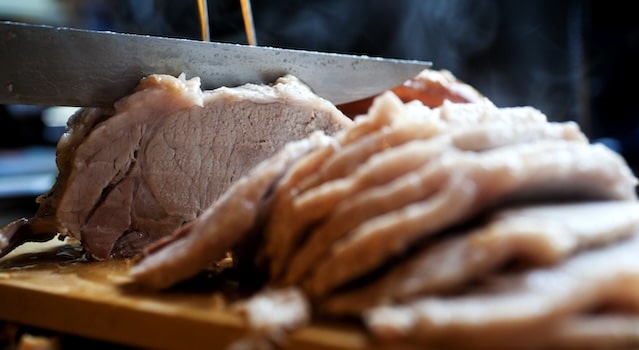
- Slice Across the Width: Now, simply carve “the short way” across the meat. By slicing across the width, you are automatically cutting across those long muscle fibres.
Why This Works
It’s simple geometry. Since muscle fibres run lengthways, splitting the meat and then slicing across the width ensures you are automatically cutting against the grain. You don’t have to study the meat; the method does the work for you. The result is consistently tender slices that practically melt in your mouth.
Let the Meat Rest First
If you take the meat straight from the fire to the knife, you’ll lose all the juices that make a roast worth eating.
- Remove from the Spit: Take the meat off the spit pole, place it in a tray, then cover with foil.
- Wait it Out: We like to give our meat a good rest. 30 minutes is best, but if you can’t wait that long, 20 minutes is okay.
- The Result: Resting allows the internal temperature to equalise and the juices to “set” back into the muscle fibres.
The Gear You’ll Actually Need
You don’t need a drawer full of specialized gadgets to get a clean cut, but having a few basics ready will make your life a whole lot easier.
- A Sharp Carving Knife: Ideally, you want a long, narrow blade. A standard chef’s knife is often too thick, whereas a carving knife lets you make those long, clean sweeps without tearing the meat.
- The Carving Fork: This isn’t just for show. It’s the best way to anchor the roast in place, keeping your hands well away from the edge of the blade.
- A Solid Cutting Board: Look for one with a “juice groove” (the little trench around the border). Trust us, when you’re carving a juicy spit roast, you’ll be glad that liquid isn’t running all over your kitchen bench.
Your Game Plan: Carving Like a Pro
- Patience First: Give the meat the rest it deserves. If you rush this, the juices will just end up on the board.
- The Lengthway Split: Cut the whole roast down the middle to create two flat, manageable halves.
- Find Your Base: Flip those pieces so the flat, cut side is down. If the meat isn’t moving, your slices will be much more consistent.
- Work Across the Roast: Start at one end and work your way to the other, cutting across the width.
- Keep it Thin: For beef and lamb especially, thin slices almost always feel more tender on the plate.
- Trust the Blade: Use long, drawing strokes. Try to avoid “sawing” back and forth; let the sharpness of the knife do the heavy lifting for you.
Pro Tips for the Best Results
- Let the Knife Do the Work: Don’t lean on the blade. If you find yourself pressing down hard, your knife isn’t sharp enough. Use a steady, drawing motion and let the edge do the heavy lifting.
- Stay Sharp: A blunt knife is actually more dangerous than a sharp one because it’s prone to slipping. Give your blade a quick hit on the honing rod before you start your first cut.
- Timing is Everything: Meat begins to dry out the moment the air hits the inside. Keep the roast whole and tucked away until your guests are actually sitting down with forks in hand.
- Steady as She Goes: Use your carving fork to pin the roast firmly to the board before you make your move.
Final Thoughts: Keep it Simple
You don’t need a degree in anatomy to carve a world-class roast. Forget the complex diagrams and just remember the basics: split the meat in half, lay it flat, and slice across it. That one simple technique will give you tender, professional results every single time, making sure your hard work on the spit gets the respect it deserves.
👉 Planning an event? Check out our spit roast catering packages.

